
All five listings here are nakiri knives, the flat-edged Japanese style built for vegetable work, so the choice comes down to steel, edge angle, and handle details stated for each blade. Sizes run from 6.5 to 7.1 inches, and edge angles run from 12 to 16 degrees where stated.
This guide works through those stated differences one knife at a time, so you can match a blade to your usual vegetables and care routine during the Black Friday shopping window.
As an Amazon Associate, we earn from qualifying purchases.
Pick by Your Need
- Best 15-Degree High-Carbon Pick: HOSHANHO 7 Inch Nakiri. A 60HRC high-carbon blade with a scallop-shaped hollow pit stated for non-stick functionality.
- Best Hammered Anti-Stick Pick: imarku Nakiri Knife 7 Inch. A hammered finish and hollow-edge design stated to reduce food sticking and drag.
- Best 6.5-Inch Damascus Pick: Shun Classic 6.5″ Nakiri. A VG-MAX core with 68 layers of Damascus cladding and a 16-degree edge.
- Best Sheath-Included Pick: KEEMAKE Nakiri Chef Knife 7 Inch. A 67-layer Damascus blade with a freestanding wooden sheath included.
- Best 12-Degree Edge Pick: Atumuryou 7” Japanese Nakiri Knife. A hand-sharpened 12-degree edge, the lowest angle stated here.
Quick Answer
The Shun Classic at 6.5 inches is the only listing under 7 inches. On edge angle, the Atumuryou states 12 degrees, the HOSHANHO and imarku state 15 degrees, and the Shun states 16 degrees, while the KEEMAKE states none. For storage, only the KEEMAKE includes a sheath.
Comparison Table
| Product | Overall Length (inches) | Edge Angle (degrees) | Weight (pounds) |
|---|---|---|---|
| HOSHANHO 7 Inch Nakiri Knife | 10.0 | 15 | 0.77 |
| imarku Nakiri Knife 7 Inch | 12.0 | 15 | not stated |
| Shun Classic 6.5″ Nakiri Knife | 13.0 | 16 | 0.47 |
| KEEMAKE Nakiri Chef Knife 7 Inch | 12.2 | not stated | 0.61 |
| Atumuryou 7” Japanese Nakiri Knife | 12.12 | 12 | not stated |
Decision Guide
Start with blade length. The Shun Classic is 6.5 inches, the HOSHANHO, imarku, and KEEMAKE are each 7 inches, and the Atumuryou spec table states 7.1 inches. None of the five listings states a board size, so match the blade length to the board you already own.
Next, compare edge angle, and count the listings first. Two listings state 15 degrees: the HOSHANHO and the imarku. One states 12 degrees: the Atumuryou. One states 16 degrees: the Shun. The KEEMAKE does not state an edge angle at all, so no single angle is shared by a majority here.
Steel is the third filter. Three listings state Damascus construction: the Shun with a VG-MAX core and 68 layers of cladding, and the KEEMAKE and Atumuryou with 67-layer construction around a VG10 core. The HOSHANHO and imarku state high-carbon stainless steel without a layer count. Hardness is stated for only two knives, the HOSHANHO at 60HRC and the Atumuryou at 62 HRC, so do not rank all five on hardness.
Handles and storage separate the group further. Four listings state a pakkawood handle: the HOSHANHO, the imarku, the Shun, and the KEEMAKE. The Atumuryou instead states a natural wood and blue resin handle. Two listings state full-tang construction: the imarku and the KEEMAKE. Only the KEEMAKE includes a freestanding wooden sheath.
Finally, note what none of these listings provides. None states a whetstone, honing rod, or sharpening tool included with the knife, and none states a blade guard other than the KEEMAKE sheath. Plan extra sharpening or storage purchases separately, and check the product page during the sale window to see current offers.
The Five Knives
1. HOSHANHO 7 Inch Nakiri Knife — Best 15-Degree High-Carbon Pick
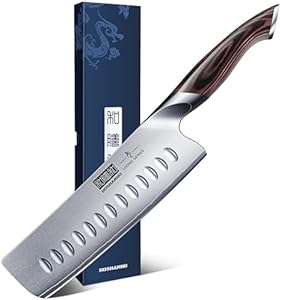
This HOSHANHO nakiri pairs a 7-inch blade with Japanese 10Cr15CoMoV high-carbon stainless steel, vacuum heat treated to a stated hardness of 60HRC. Each blade is hand-polished to a 15-degree edge, and the blade side carries a scallop-shaped hollow pit stated to offer non-stick functionality. At 0.77 pounds it is the heaviest of the three listings that state a weight, and its 10.0-inch overall length is the shortest of the five.
Pros
- Stated 60HRC hardness after vacuum heat treatment, 1 of only 2 hardness figures stated here
- Scallop-shaped hollow pit on the blade side, stated to offer non-stick functionality
- Pakkawood handle with a natural grain stated to complement the matte blade finish
Cons
- Stated overall length of 10.0 inches is the shortest here, which may feel short if you expect a longer handle-to-tip span
- The listing does not state a sheath, blade guard, or any included storage
| Spec | From the listing |
|---|---|
| Color | Silver |
| Size | 7″ |
| Length | 10.0 inches |
| Width | 2.0 inches |
| Height | 2.7 inches |
| Weight | 0.77 pounds |
2. imarku Nakiri Knife 7 Inch — Best Hammered Anti-Stick Pick

The imarku listing leads with surface texture: a hammered finish, hollow-edge design, and mirror-polished spine on a 7-inch blade, stated to reduce food sticking and drag. Its 15-degree edge matches the HOSHANHO as 1 of 2 listings at that angle, and the high-carbon stainless steel is stated to resist rust, stains, and tarnishing. Care is explicit here: this knife is hand wash-only, and its stated height of 0.09 inches is the thinnest profile in the spec tables.
Pros
- Hammered finish and hollow-edge design stated to reduce food sticking and drag
- Full-tang construction with an FSC-Certified deep brown pakkawood handle
- Care is stated directly: hand wash-only, with resistance to rust, stains, and tarnishing
Cons
- Hand wash-only care rules out dishwasher washing for this knife
- The listing does not state a weight, so its balance in hand cannot be compared on that number
| Spec | From the listing |
|---|---|
| Color | Deep Black Brown |
| Size | 7″ |
| Length | 12.0 inches |
| Width | 2.0 inches |
| Height | 0.09 inches |
| Weight | The listing does not state it |
3. Shun Classic 6.5″ Nakiri Knife — Best 6.5-Inch Damascus Pick

The Shun Classic is the specialist here: at 6.5 inches it is the only blade under 7 inches, and its listing states it is designed for slicing and dicing vegetables. The VG-MAX core carries 68 layers of Damascus cladding, the highest layer count stated here, finished to a 16-degree edge. Its D-shaped pakkawood handle is stated to suit both left and right-handed users, a detail no other listing states, and at 0.47 pounds it is the lightest of the three knives that state a weight.
Pros
- 68 layers of Damascus cladding over a VG-MAX core, the highest layer count stated here
- D-shaped pakkawood handle stated to work for both left and right-handed users
- Lightest stated weight at 0.47 pounds; longest stated overall length at 13.0 inches
Cons
- The 6.5-inch blade is the shortest here, with less straight edge per stroke than the 7-inch models
- The listing does not state a hardness figure, unlike the 2 listings that state 60HRC or 62 HRC
| Spec | From the listing |
|---|---|
| Color | Black |
| Size | 6.5″ |
| Length | 13.0 inches |
| Width | 2.38 inches |
| Height | 0.9 inches |
| Weight | 0.47 pounds |
4. KEEMAKE Nakiri Chef Knife 7 Inch — Best Sheath-Included Pick

The KEEMAKE stands apart on what comes with the knife: a handcrafted wooden sheath with a freestanding design, the only included storage stated here. The 7-inch blade uses a VG10 core wrapped in 67 layers of Damascus steel, with a hand-hammered finish stated to help minimize food sticking. Construction is full-tang with a triple-riveted pakkawood handle, and the stated weight of 0.61 pounds sits between the Shun and the HOSHANHO.
Pros
- Freestanding wooden sheath included, the only storage accessory stated here
- 67-layer Damascus construction around a VG10 core, with a hand-hammered finish
- Full-tang construction with a triple-riveted pakkawood handle
Cons
- The listing does not state an edge angle, while the other 4 listings state 12, 15, or 16 degrees
- The listing does not state a hardness figure for the VG10 core
| Spec | From the listing |
|---|---|
| Color | Silver |
| Size | 7″ |
| Length | 12.2 inches |
| Width | 2.09 inches |
| Height | 0.9 inches |
| Weight | 0.61 pounds |
5. Atumuryou 7” Japanese Nakiri Knife — Best 12-Degree Edge Pick

The Atumuryou states the lowest sharpening geometry here: a 12-degree edge, hand-sharpened on traditional Japanese whetstones, on a tall, straight blade for slicing, dicing, chopping, and julienne cuts. Its 67-layer Damascus construction wraps a VG10 core at 62 HRC, the highest hardness stated here. One detail differs within the listing itself: the title states a 7-inch blade while the spec table states 7.1 inches. Its natural wood and blue resin handle is the only non-pakkawood handle here.
Pros
- 12-degree hand-sharpened edge, the lowest edge angle stated among the five listings
- 62 HRC VG10 core, the highest hardness figure stated here
- Tall, straight blade stated for slice, dice, chop, and julienne work
Cons
- Blade size is stated as 7 inches in the title and 7.1 inches in the spec table
- The listing does not state a weight, so it cannot be compared with the 3 listings that state one
| Spec | From the listing |
|---|---|
| Color | Wood |
| Size | 7.1″ |
| Length | 12.12 inches |
| Width | 2.1 inches |
| Height | 0.1 inches |
| Weight | The listing does not state it |
Black Friday Shopping Checklist
- Write down your target blade length first: 6.5 inches, 7 inches, or 7.1 inches in the Atumuryou spec table.
- Note your edge angle among the stated 12, 15, and 16 degrees; the KEEMAKE listing does not state one.
- Decide on steel before the sale event: high-carbon stainless, or Damascus over a VG10 or VG-MAX core.
- Add a sheath or guard to your wishlist for any knife other than the KEEMAKE, the only listing stating included storage.
- Check whether hand wash-only care, stated for the imarku, fits your routine before you order.
- Save the 5 product names to your wishlist so you can compare them again on Cyber Monday.
FAQ
Is a nakiri the right shape for everyday vegetable prep?
Yes, based on what these listings state: a nakiri has a tall, straight blade, and the Atumuryou listing states that shape gives a stable cutting surface for slicing, dicing, chopping, and julienne cuts. The Shun listing likewise states its 6.5-inch nakiri is designed for slicing and dicing vegetables.
How do I choose between a 12-degree and a 16-degree edge?
Compare the stated angles directly: the Atumuryou states 12 degrees, the HOSHANHO and imarku state 15 degrees, and the Shun states 16 degrees. The listings do not state a resharpening interval for any of them, and the KEEMAKE listing does not state an edge angle at all.
Do any of these knives come with storage included?
Only one does: the KEEMAKE listing includes a handcrafted wooden sheath with a freestanding design. The other four listings do not state a sheath, guard, or storage accessory, so factor a separate guard into your shopping list for those four.
Final Verdict
For a vegetable-first knife, the Shun Classic is the most specialised listing here, with a VG-MAX core, 68 layers of cladding, and a handle stated to suit left and right-handed users. For the lowest stated edge angle and highest stated hardness together, the Atumuryou pairs a 12-degree edge with a 62 HRC core, subject to its 7-inch versus 7.1-inch size wording. For included storage, the KEEMAKE is the only listing that states a sheath. The HOSHANHO and imarku are the high-carbon stainless options, both 7 inches and 15 degrees, separated by the HOSHANHO hollow pit and the imarku hammered, hand wash-only finish.
Prime covers fast, free delivery on eligible items. See whether a Prime free trial is available for your account.
Check Prime on Amazon →Related Guides
Product and ASIN Reference
| Product | ASIN |
|---|---|
| HOSHANHO 7 Inch Nakiri Knife | B0CWH4MF7W |
| imarku Nakiri Knife 7 Inch | B0FXMMP411 |
| Shun Classic 6.5″ Nakiri Knife | B000FR2YWK |
| KEEMAKE Nakiri Chef Knife 7 Inch | B0GVXPYF1C |
| Atumuryou 7” Japanese Nakiri Knife | B0H9WLVGBP |

Write Your Review
No reviews yet. Be the first to share your experience!